USDA Loans
USDA loans are one of the few paths to a home on Oʻahu with zero down payment — and no, you don’t have to be a farmer to use one. Backed by the U.S. Department of Agriculture, they help low- and moderate-income buyers purchase in eligible areas. Here’s how they work and how our team can help you find out if you qualify.
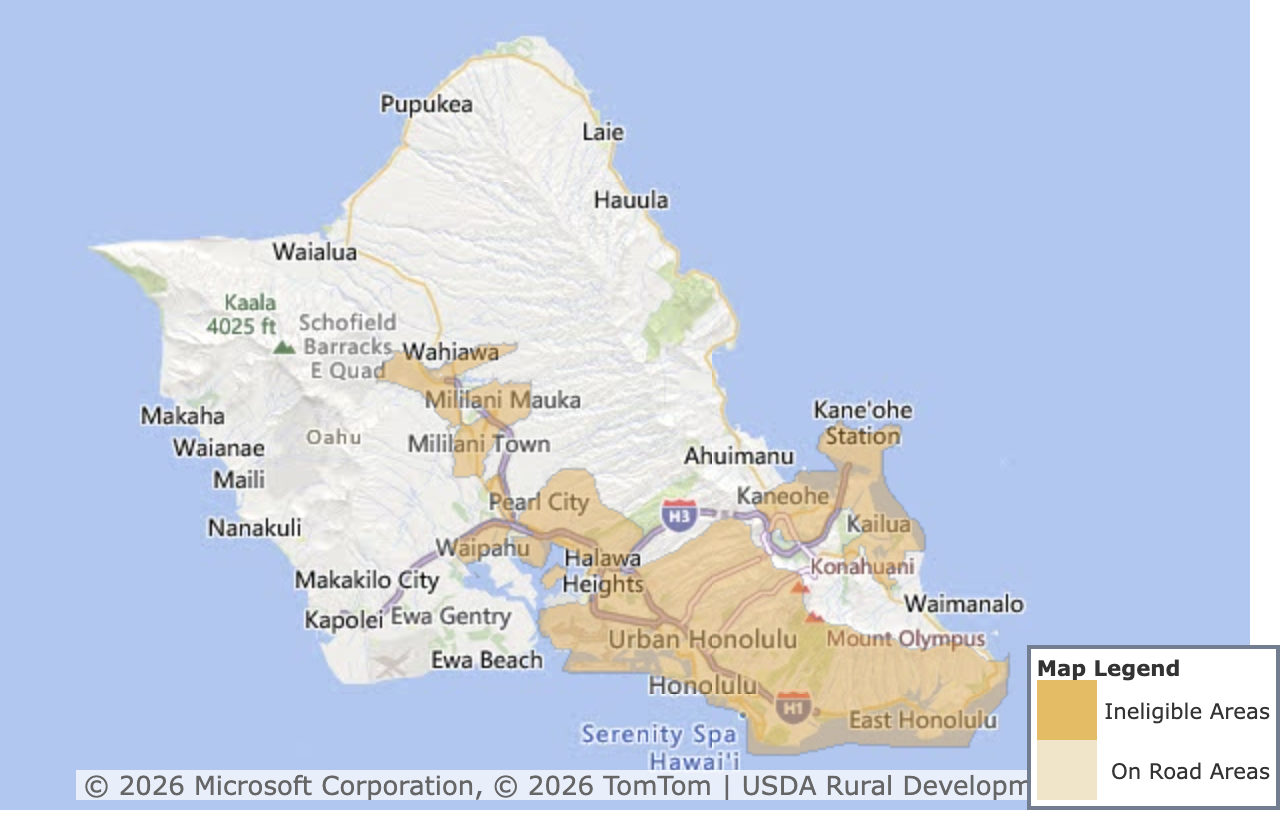
Map shown for reference only — eligible areas are updated periodically, so always confirm a specific address on the live USDA map (linked below).
🌾 What Is a USDA Loan?
USDA stands for the U.S. Department of Agriculture. Through its Rural Development program, the USDA guarantees mortgages made by approved local lenders — much like FHA and VA loans — so lenders can offer 100% financing (no down payment) at competitive fixed rates.
The program is designed to support homeownership in rural and suburban areas. Because Oʻahu is densely populated, only certain geographic areas qualify — but more of the island is eligible than most people expect.
💰 Key Benefits of a USDA Loan
- Zero down payment — finance up to 100% of the home’s value
- No set maximum purchase price on the common Guaranteed loan — your maximum is based on your income and ability to repay, not a fixed cap
- Lower ongoing fees than FHA mortgage insurance
- Competitive 30-year fixed rates that won’t change over the life of the loan
- Gift funds and seller-paid closing costs are allowed
🗺 First Question: Is the Property in an Eligible Area?
USDA eligibility is geographic. On Oʻahu, areas like ʻEwa, ʻEwa Beach, and Kapolei — along with parts of the North Shore and Windward side — have long been popular USDA-eligible areas. Urban Honolulu and the densest neighborhoods are not eligible.
Because the USDA updates its maps from time to time, the only way to know for sure is to check the exact address on the official tool:
👉 Check a Property’s USDA Eligibility
✅ Second Question: Do You Meet the Income Limits?
Because USDA serves low- and moderate-income buyers, there’s a cap on household income — set by county and household size, at roughly 115% of the area’s median income. One thing that catches buyers off guard: USDA counts the income of every adult in the household, even those not on the loan.
Here’s the good news for Oʻahu: because Hawaiʻi is such a high-cost area, the limits are far higher than on the mainland — for a 1–4 person household on Oʻahu, the cap generally lands in the $145,000–$160,000 range (and higher for larger households). Many local buyers who assume they earn too much actually qualify.
Because these limits update each year and the exact figure depends on your household, confirm yours with the USDA’s official income tool or your lender:
👉 Check Your USDA Income Eligibility
🧾 USDA Guarantee Fees
USDA loans don’t use traditional mortgage insurance. Instead, there’s a guarantee fee that keeps the program running — and it’s generally cheaper than FHA mortgage insurance. There are two parts:
- Upfront guarantee fee: currently 1.0% of the loan amount (usually financed into the loan rather than paid in cash)
- Annual fee: currently 0.35% of the loan balance per year, split into your monthly payment
Together, these are part of what makes USDA one of the more affordable monthly options for buyers who qualify.
🏠 What Kind of Property Can You Buy?
USDA loans are for a primary residence in an eligible area, and can be used for:
- Single-family homes
- Townhomes and many condominiums that meet USDA requirements
- Modest homes in eligible neighborhoods — no working-farm requirement
The home must also pass an appraisal confirming it meets USDA condition and safety standards. Vacation homes and investment properties don’t qualify.
🤝 How Our Team Can Help
USDA has a few moving parts — the property has to be in an eligible area, your household income has to fit, and the maps change over time. We help you sort it out before you fall for a home that won’t work.
As a top-performing team at REMAX Hawaii West Oʻahu, we help Oʻahu buyers:
- Identify USDA-eligible neighborhoods in the areas you want to live
- Check whether your household likely fits the income limits before you invest time
- Connect with experienced USDA-approved lenders from our preferred list
- Confirm a specific property’s eligibility on the current USDA map
- Keep your transaction on track from offer to closing
❗ Important Things to Know Before You Apply
Eligibility Maps Change
An area that qualifies today may not later, and vice versa. Always confirm a specific address on the live USDA map before getting attached to a home — we’re glad to check it with you.
All Household Income Counts
USDA looks at the income of every adult living in the home, not just the borrowers. This surprises some buyers, so it’s worth reviewing early.
Always Confirm With Your Lender
USDA income limits, fees, and eligible areas can change, and every situation is different. It’s always best to confirm the current details with a USDA-approved mortgage loan originator. Contact us and we’ll get you a list of our preferred USDA-approved lenders.
🏠 Ready to Take the Next Step?
If a zero-down home in an eligible Oʻahu neighborhood sounds like your path, let’s find out if it fits. We’ll help you check the area, the income limits, and the right lender — all in one place.
Curious If a USDA Loan Works for You?
Find out if your target area and income qualify, get matched with a trusted USDA-approved lender, and start touring homes — or just ask us anything.
Or call or text (808) 351-8394 · TeamCastaneda@REMAXHawaii.com
Joe Castaneda (R) RB-23007 · REMAX Hawaii
For official USDA loan information, visit USDA Rural Development. Eligible areas, income limits, and fees are subject to change. Figures shown reflect 2026 USDA guidelines. This page is for general information only and is not a commitment to lend; consult a USDA-approved lender for guidance specific to your situation.